Friday, January 31, 2014

Social Media Involvement With Cities


Nowadays, it is obvious how much social networks are a part of people’s everyday lives.  It is rare to find someone who is not on at least one social network, assuming they are from a younger generation. An interesting question can come from this situation, that is: is there a city that values social networking over another city? The article “Why London Comes Last in Social Media City Rankings,” answers this question.

First off, the author introduces some statistics about the most popular accounts on Twitter, based on their followers. Some have nearly fifty million users following them. This is far greater than the population of most cities in the world. After this, we become aware of some of the various major cities throughout the world and there relationship with the numerous social networks. Statistics were taken from the various social networks and the study concluded the rate at which these major cities used social networking.

Surprisingly, a major city, London, came in last place on this list. London is a major metropolitan city and it is interesting that it ranks last on this list. However, the overall study even being performed shows how important social networks have become. Cities themselves even have Twitter and Instagram accounts that are used and looked at on a daily basis by many people. This shows that if a city can effectively use social networks, they can interact even more with their residents and it will be interesting to see what the relationship between social media of cities and the population evolves into. 

Check out the article itself: http://www.technologyreview.com/view/524056/why-london-comes-last-in-social-media-city-rankings/

Changing World of Journalism

            After reading Jeff Jarvis's article called Buzz Machine, I developed some new knowledge relating to some current events in the journalism world.  I was surprised to read that some of the top journalists around the world have left powerhouse media companies like The New York Times and The Wall Street Journal to work at younger and newer companies.  Jarvis talked about Ezra Klein and his move to Vox Media, while pointing out the developing turn in journalism.  Jarvis's main argument in his blog article was highlighting and arguing some aspects of Klein's beliefs on how to successfully put forth good journalism in today's evolving society.  Jarvis argued Klein's point that tech companies producing journalism supersede journalism companies that do tech. Jarvis writes, "I disagree as I think concentrating on technology as the root of value is still an expression of editorial ego: it’s about how *we* do our jobs rather than how the public benefits from the services we perform".
     
          I tend to disagree with Jarvis's claim as I feel today's journalism requires public interest in order for the company to remain successful.  Everyone in a particular company could be doing their jobs admirably but still see the company fail because they aren't distributing their information in a way that acquires readers.  I agree strongly with Klein's ideology he is preaching at Vox Media, which is focusing less on the broader simple news reporting, but rather targeting a specific asset of news: the explainer.  Jarvis seems to believe this is a smart tactic by new media companies while it attracts the interest from bigger name journalists to involve themselves in this kind of project.  Overall, I found this article to be informative and leads ourselves to consider the changes that are progressing in journalism.
http://buzzmachine.com/

Twitter, Accommodating to Impatience

            Anyone who has a cell phone knows that there is always the need to refresh our social media applications. For example, when scrolling through Twitter people are constantly tweeting, which means constant refreshing to see what is next. Well what happens when there is nothing to refresh? Twitter understands that living in modern society means that we have a constant need for speed. With our short attention spans, we are constantly swiping to see what someone else has to say. 
Twitter's company has just developed a plan to accommodate the mobile users who are constantly refreshing. Their solution is to show content that will distract their users until more content is available. This particular content would consist of suggested accounts that users would like to follow or any news that is trending out there in the world of social media. The company says that users may have to pay for this resource in the future, but they have not come to a final decision. 
What has made Twitter so addictive is the simple pleasure of scrolling up and down the glossy screen of a cell phone to find what is next. This action causes for nearly 2 billion timeline views a day. But, if Twitter is making a tenth of a penny every time a user refreshes their tweets, why would they try to decrease the amount of timeline views if they can bank on it?

Article Link: http://bit.ly/MncYFl

-Sophia Morris-

"Privacy" on Facebook is Not Protecting

http://bit.ly/1cO4j8o


Although social media is a great way to stay connected and up to date with friends, family, and the latest news, there are also a lot of negatives that come along with being so affixed in the online world.  Over the past couple years, Facebook has really taken off in popularity with preteens and teens.  In order to protect its members, there are a variety of settings to play around with in choosing privacy  or publicity.  Last week, Facebook opened the option to teens, ages 13 to 17, to share the information they post on their account with not only their “friends”, but everyone.  In doing this, they’re trying to make teens aware of their choices.  Upon making their account public, they receive both a notification and a reminder to make sure it’s a change they really want to make.   I think this is a good idea because it’s just a first step in helping teens learn internet safety and maybe learn that although they’re “friends” with everyone on Facebook, it doesn’t mean they have to be in real life.
By allowing teenagers the ability to share their personal information and photos with everyone, it’s pushing them into the public world quicker.  For some, this is their first experience in a public world.  On the topic of “coming of age” and growing up, there is not one particular event or happening that causes anyone to go from a child to adult in a days length of time.  Transitioning into adulthood and the public world is a gradual process and it’s crucial that teens learn to do so.  Some parents are arguing about protection and privacy purposes.  With everyone able to see Facebook, it’s exposing kids and could be dangerous.  Parents need to learn the mechanisms of educating their children on internet safety.  
Instead of sheltering teens from all risks, they’re saying it’s important to constructively fuse them into today’s culture.  They want to not just provide teens with secure technology, but to provide the parents and teens with information about security with technology.  I don’t think it is technology’s job to monitor what kids are saying and doing on the internet, it’s the parents' job.  

Thursday, January 30, 2014

Netflix and Disney's Marvel team up

As some may know recently Disney's Marvel, has signed a contract with Netflix stating Marvel will create multiple "original live-action series" to be released exclusively on Netflix. These series will feature Marvel heroes such as Daredevil and Iron Fist in an epic story taking place in the dark and ominous world of "Hell's Kitchen" New York. Netflix has committed to four series all thirteen episodes in length, unraveling over the next few years starting in 2015.

Also out of this deal Disney has promised to create animated and live-action films by companies like Walt Disney Studios, Disney Animation Studios, Pixar, and Lucas-Arts (Star Wars), only to be released on Netflix. Some believe this to be because of Disney's recent box office flops like "The Lone Ranger" and "John Carter."

As great as this deal sounds the Netflix users, it also leaves you wondering if TV itself will make a switch to having exclusive Netflix released shows, making cable a thing of the past.

Check out the Marvel/Netflix Story here http://marvel.com/news/tv/2013/11/7/21476/disneys_marvel_and_netflix_join_forces_to_develop_historic_four_series_epic_plus_a_mini-series_event

Arbys: Good Old Tweet Fashion


Again real-time marketing proved to be one of the most powerful methods of story telling for brands with Arbys' tweet during the Jan 29 Grammys at Pharrell Williams commenting on his oversized Vivienne Westwood hat choice:


This quick reaction to a real-time event with a real-time response has proven to be invaluable in branding. Fellow St. John Fisher students admitted in classes today, while discussing the topic, that they started follow Arby's just because of this one genius tweet. 


The best part for Arbys? They didn't have to pay for a commercial on the Grammys to get  advertising through the Gammys. As little as 24 hours after Arbys' posted their tweet it had 77,000 RT and 40,00 favorites on Twitter. The clever Pharrell William's also Tweeted back at Arby's in what they couldn't have asked to be better product placement:


The proof is in the cookie if you're skeptic of real-time marketing doesn't count except to get a front page article on AdAge. Oreo was able to grab the attention of some 24.1 million Tweeters updating during last years Super Bowl. During the 34 minute power outage, when Oreo updated, there was an average of 231,500 tweets per minute. That's a lot of active users and a lot of eyes to be in front of at one time in such a personal, non-invasive way. Kevin Weil, Twitter's VP of production for revenue said brands who get interaction by tweeters through replies or re-tweets see on average of 12% increase in sales.


In this world of real-time media, you really do have to come up with a big idea, and quickly. It took advertisers just four minutes to have the first promoted tweets up against "power outage" searches on Twitter during last years Super Bowl. 


Though you shouldn't try too hard with real-time marketing if you missed the moment or you'll end up looking like you're just trying to piggyback off another brands shinning moment. A great example of this was also shown through tweets during the Grammys after Arbys tweet:


Though Gain did get some attention using this technique:


You can see more of the Grammy tweet flops through DigDay's: The Grammys As Seen Through the Eyes of Brand Tweets -- note the amount of retweets and favorites of most of these piggy backing brands. 

Everyone was going to be talking about Pharall Williams' hat the next day, but Arbys was able to steal some of that spotlight. I'm excited to see what kind of real-time marketing the Super Bowl on Sunday brings with all this competition to connect brand stories to high profile events. All major advertising teams and agencies will have their eyes peeled to the screen for their moment to shine and it at least makes for some good case studies. 


Original Story Source:  Ad Week: Arbys Slayed Grammys Tweet About Pharrell Williams hat  Posted January 27th by David Griner


Who thought binging could be so good?

Binge watching has become a part of many of our lives, myself included.  Most people have started to prefer to watch their shows on demand, and set aside long periods of time to catch up or just crank through a new season all in one go.  The average number of episodes per binge watch is 2.3, so those full day blow outs aren’t becoming common practices just yet.

Netflix has been leading this revolution of on-demand and binge watching TV shows, and I for one have embraced it.  I have countless episodes at my fingertips just waiting to be watched.  How could I resist?

These changes create a whole new concept of the television world.  Instead of people asking “Did you see that episode last night?” it’s more of, “Did you finish that show yet?” 

Is binging necessarily a good thing?  Users say yes, with 73% saying it is a positive thing.  However, I think too much of anything can prove to be harmful. If as a society we decide this is the best way to watch television, by spending 3+ hours at a time in front of a screen, then maybe this isn’t a good thing.

http://on.mash.to/1bElK7S

A glimpse into the rapidly evolving social media world of China

China’s social media world seems as if it is in a different galaxy than the world we know.  Without Facebook, Twitter, or YouTube, Chinese citizens have finally adopted their own social media platform, Weixin, which has grown to over 300 million users in merely three years.  Statistically, it has outperformed Twitter and Facebook in terms of popularity and it is even giving China’s largest mobile phone company’s message service a run for its money.  The developer of this app, Tencent, is already facing fierce competition from other software developers who are realizing the direction that the market is headed in.


We take it for granted that we have already hit and adapted to the social media revolution.  As for a country the size of China, this digital revolution could potentially warp the social media environment in China forever.  Weixin is even available outside of China as WeChat.  


Indisputably, this immense popularity of Weixin is changing the perspective of other nations on China’s internet companies. Companies that formerly seemed "cheap" and knockoffs of U.S. companies are becoming legitimate and powerful.  China is experiencing an onset of more professional internet companies, which have begun to rival those which grew out of the U.S.

As Weixin has already cut deeply into telecommunications and existing social media in China, one can only wonder what will be next.  Will China become reconnected with the rest of the online world?  Is Weixin going to lead to the establishment of China as a force to reckon with on the internet?

The contagious nature of this social media website has made it extremely powerful and only added to its potential to grow. Soon enough, we may start to see our own social media websites of choice start to mirror the layout and design of this prodigious new platform.

See the full article on The New York Times, published on Jan. 20, 2014 http://nyti.ms/1ek80nnhttp://nyti.ms/1ek80nn

Wednesday, January 29, 2014

Facebook Plans to Launch More Standalone Apps Like Messenger


In early 2011, Facebook launched a stand-alone application for messaging. Mark Zuckerberg the CEO of Facebook stated that this was made to create more room on the site for more add-ons and to be able to expand on the application. He also explained how it would be easier to add-on by completing updates on the app stores instead of the whole site, which is more difficult. Since the release, the messenger app has added more emojis and name recognition. The sales for the app have recently sky rocketed with a seventy percent increase of new users in a three-month period. Another benefit for creating a stand-alone messaging app is that the space saved on the site can lead to Facebook groups.  


The CFO, David Ebersman has even hinted on more stand-alone apps that might join the ranks of the messenger app. For example, a newsreader application and a calendar application. Both of these would be linked with Facebook. Zuckerberg also mentioned on how the company’s newest focus for improvement will be in the area in which seem to be growing not only with their company but also with others that oppose them like Instagram and Messaging.

http://mashable.com/2014/01/29/facebook-standalone-apps/

Is Google+ Planning to Hand Out Users’ Personal Information?

“Don’t give out personal information online.  Give nobody in cyber space access to your phone number, location, age… or email address.”

This is drilled time after time into the minds of those learning to use the web.  It seems, after all, that with this information it’s much easier for hackers, predators, and identity thieves to take advantage of a web user.  Times are changing now, with many websites plainly displaying much of this information.  The prominence of social media is contributing to this- often times in a Twitter or Facebook bio, personal information such as hometown, age, birth date and full name is just a click away.

What’s the way to avoid this? Put your privacy settings on “high.”  Don’t make an account on these sites in the first place.  Make an anonymous account.  Be happy with a simple email account for the necessary cross-web communications.  This seems simple, right?  Unfortunately, it’s not so easy anymore. 

No longer is email, the sort of “horse and buggy” of web communications, going to be quite as private.  The ever-so reliable Google Corporation, holding the personal information of more than 18,915,810 people nationwide (it was 18,915,810 in 2012 according to a post on the Google+ website itself, http://tinyurl.com/kreaztm) , is now going to display it freely and without users’ permission. 

You know when you begin to type somebody’s email address into the “recipient” box, and if they’re already in your contacts list the address auto-fills or gives a list of full contact names and email addresses you can click on as a short cut? This is going to start happening even when someone’s contact is not already in your address book.  Any Google+ account username deemed a “connection” will be displayed when you begin typing the beginning series of characters. 

There is no end to the repercussions of this.  Issues involving stalkers is mentioned in the CNN’s article (click the following link to view article http://preview.tinyurl.com/kpbt36m ).
The intent of this feature is to allow a user to reconnect with people they may have known but had lost or never remembered to write down their email address.  This is a nice sentiment although not what users have been asking for.


What is the response going to be when a few teenage kids decide to send out prank emails to random addresses?  When clicking on an auto-filled name, the kids know that they’re sending it to a valid account.  One “innocent prank” consisting of a nasty email threatening or bullying somebody could (in an extreme case) drive somebody over the edge, to commit suicide or violence.  One unsolicited message could essentially end a person’s life.  This is a drastic example, but powerful nonetheless.  When concerns of privacy are involved, corporations should always air on the side of withholding.  

The Nation Loves Twitter Drama

On Sunday, January 19th, the Seattle Seahawks withstood a late fourth quarter drive by the 49ers, hinged on an amazing defensive play by cornerback Richard Sherman. As the play concluded, words were exchanged with him and San Francisco wide receiver, Michael Crabtree. Although they both walked off the field and the battle of football had ended, the battle of pride continued off of the  field.

During the post game interview, Sherman was very passionate with his response. He called out Crabtree by exclaiming that he was the best cornerback in the game and made a stern statement to him, stating, "Don't you ever talk about me!"

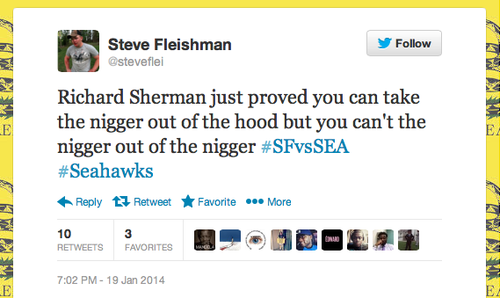
As expected, Twitter exploded with the opinions of thousands regarding his actions in the interview. Judgmental, hateful, hurtful, and ignorant tweets were posted discussing Sherman's behavior after the game. He was called a thug, tasteless, uneducated, and even as low as being called a nigger.


As a nation, we love this kind of drama because it is our entertainment. Twitter allows anyone at any time to share their opinion about anything. With people's opinions comes the responses to those opinions, which frequently turns into what has become known as "Twitter Drama."

Sherman was a graduate of Stanford with a 3.9 GPA, and has never had a violation with the NFL (not even as small as cussing in an interview). But the people love the drama it creates and regardless of what people have done in the past, a "poor decision" will be harped on through Twitter.

The amount of "Twitter Drama" that this incident created was nearly immeasurable.  There were plenty of people who belittled Sherman, and many who stood up for him and his passion for the game. As one could image, these people bumped heads and loved debating the situation over Twitter. I feel bad for Sherman and the corrupt things that were said about him, but at the same time, it made for one hell of an evening on one of the most used applications in the world.

For more information regarding Richard Sherman and the media surrounding him, go to http://mashable.com/2014/01/28/richard-sherman-owns-the-media/?utm_cid=mash-com-Tw-main-link